Blog Post Collection | Plauderblog
Safety data sheets for Germany and the EU: what is new in our SDS Generator
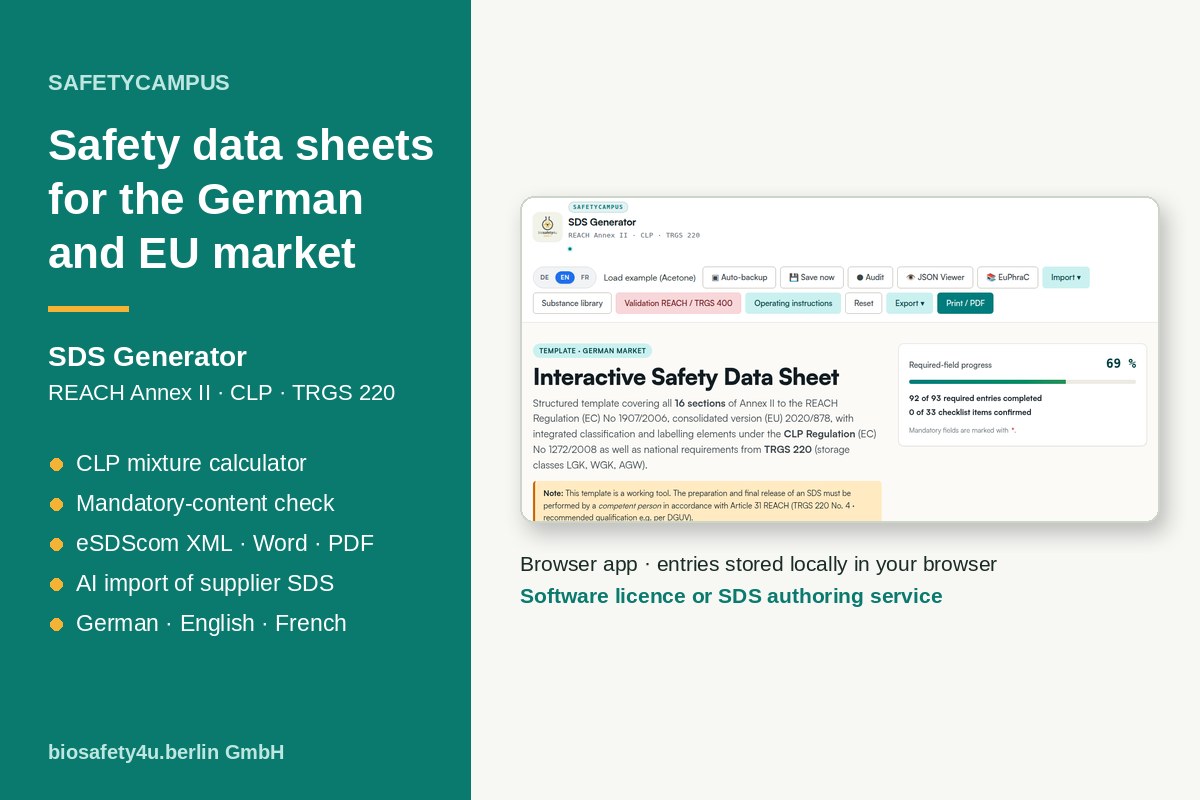
Placing a chemical product on the German or EU market means supplying a safety data sheet that follows Annex II of REACH, reflects the current CLP classification and – in Germany – the national Technical Rules for Hazardous Substances. With version 10V19sC21 of 18 November 2026, our SafetyCampus SDS Generator has received a major update. You can write your safety data sheets yourself with the software, or have us prepare them for you.
Two ways to a compliant safety data sheet
Under Annex II of REACH, as amended by Regulation (EU) 2020/878, a safety data sheet must be prepared by a competent person and follow 16 sections with fixed headings. For the German market, it must also be supplied in German (Article 31(5) REACH), and German authorities expect the national details set out in TRGS 220, such as occupational exposure limits, the water hazard class and the storage class.
DO IT YOURSELF
SDS authoring software
For manufacturers, importers, distributors and formulators who create safety data sheets regularly and want to keep the process in-house.
DONE FOR YOU
SDS authoring and review service
We prepare, translate or review your safety data sheets as a competent person under REACH – in German, English or French, using the same software.
What is new in the updated SDS Generator
- Up-to-date classification data – the substance library is based on the harmonised entries in Annex VI of the CLP Regulation, including the amendments of Delegated Regulation (EU) 2025/1222, which applies from 1 February 2027. The app shows which entry applies on which date.
- New CLP hazard classes – endocrine disruption for human health and for the environment, PBT/vPvB and PMT/vPvM, as introduced by Delegated Regulation (EU) 2023/707.
- CLP mixture calculator – classification of mixtures by the calculation methods of CLP Annex I, taking specific concentration limits, M-factors and the acute toxicity estimate of the mixture (ATEmix) into account. Every result comes with a traceable calculation trail, and you decide whether to adopt it.
- Output that matches Annex II – official headings for all 16 sections and their subsections. Fill-in hints and internal notes never appear in the printed document.
- Case-dependent completeness check – the app checks the mandatory content that applies to your product, for example each physical and chemical property in subsection 9.1 and each hazard class in subsection 11.1, and the hazard-determining components on the label (Article 18(3)(b) CLP). It also flags contradictions between sections. Incomplete documents can only be exported as clearly marked drafts.
- German national details built in – occupational exposure limits from TRGS 900 and TRGS 910, the storage class under TRGS 510 and the water hazard class.
- AI-assisted import of supplier SDS – upload an existing safety data sheet as a PDF and the app pre-fills the fields. Every imported value is marked for review before it goes into your document.
- Data exchange and records – export to Word, PDF, Markdown and JSON, plus export and import in the industry standard eSDScom 5.5, validated against the official schema. An audit package with checksums documents each released version.
- Beyond the SDS – operating instructions for the workplace under TRGS 555, a control banding module based on the German BAuA EMKG (including in-house dilutions with water) and a UFI generator.
New in version 10V19sC21
Compared with the previous version 10V18sB5 of 28 August 2026, the SDS Generator has been fully revised:
- EUH codes for the new hazard classes – EUH380/381 and EUH430/431 (endocrine disruptors), EUH440/441 (PBT/vPvB) and EUH450/451 (PMT/vPvM), with the signal word “Danger” for vPvB and vPvM. Older drafts are converted automatically.
- Substance library at ATP 23 – 221 substances newly taken from CLP Annex VI, 157 entries corrected, acute toxicity per route of exposure. Until 31 January 2027 the version currently in force is the default; you can select the ATP 23 version in advance, and a comparison view shows the differences.
- Occupational exposure limits from TRGS 900, version of 5 June 2026 – including peak limitation and remarks, e.g. methanol 130 mg/m³, ethanol 380 mg/m³, acetonitrile 17 mg/m³; acceptable and tolerable concentrations under TRGS 910.
- Mixture calculator – acute toxicity (ATE), summation method for skin and eyes, aquatic hazards with M-factors, specific concentration limits, STOT and aspiration. Transfer the result to sections 2 and 3 with one click.
- Mandatory-content check per section – missing information appears in the SDS as “[information missing]”. An incomplete SDS can only be exported as a clearly marked DRAFT; a fill-in aid adds standard phrases such as “No data available.” where needed.
- New SDS output – official section headings in German, English and French, page 1 with all details required by REACH Annex II 0.2.5, “Page X of Y” numbering, a components table in section 3 and a limit-value table in section 8. Internal working notes go into a separate review log.
- Seveso III / German Major Accidents Ordinance – suggests the Seveso categories H1 to O3 in subsection 15.1 based on the classification and recognises named substances by CAS number. Unclear assignments are flagged “conditional – check”, and nothing is applied without your click.
- eSDScom 5.5 – export validated against the official schema, and now also import of eSDScom files. Export and re-import preserve all data.
- Improved AI import – old H codes are converted to the new EUH codes automatically, components go straight into the mixture calculator, and the mandatory-content check runs afterwards.
- Further corrections – references to TRGS 220 and TRGS 510 corrected, EMKG fire and explosion hazard groups for solids corrected, and the standard statement in 2.2 for unclassified mixtures: “No labelling elements required according to Regulation (EC) No 1272/2008.”
Key dates at a glance
- New hazard classes (Regulation (EU) 2023/707) – substances since 1 May 2025, substances already on the market since 1 November 2026; mixtures since 1 May 2026, mixtures already on the market from 1 May 2028.
- ATP 23 (Regulation (EU) 2025/1222) – applies from 1 February 2027.
- CLP revision (Regulation (EU) 2024/2865) – from 1 January 2027, the label must also name the substances relevant for the ED, PBT and PMT classes. The new rules on label format, relabelling, advertising and distance selling have been postponed to 1 January 2028 (Regulation (EU) 2025/2439).
- Omnibus VI – not yet in force. The European Parliament adopted the agreement on 22 October 2026; formal adoption by the Council and publication in the Official Journal are pending (as of 19 November 2026). The plan is to postpone the application of the revised CLP rules to 1 January 2030. We will update the SDS Generator as soon as the text is published in the Official Journal.
- ADR 2027 – applies from 1 January 2027; ADR 2025 may still be applied until 30 June 2027. Section 14 points out the transition.
Your responsibility stays with you: the SDS Generator supports the competent person – it does not replace their assessment. Calculated classifications and imported values must be checked before release. The app does not submit data to ECHA or to poison centres.
Current version: 10V19sC21 · Release date: 18 November 2026
Hosted or on your own server
- Hosted (SaaS) – use the SDS Generator in your browser directly from our server, without installation.
- On-premises – the Standard edition runs on your own web domain or on your intranet server. A browser-based desktop or notebook edition is available on request.
- Your data stays with you – SDS data stays in your browser. Only the licence key, app ID and version are sent to the server – and, when you use the AI import, the PDF for analysis.
- Licence via the SafetyCampus Client Area – a key stored there is applied automatically. Without an internet connection, the app remains usable for up to 14 days after the last online confirmation; first activation always requires a connection. New in the footer: sign out of the licence, e.g. on shared computers – your SDS drafts are kept.
- Three languages – user interface and safety data sheet in German, English and French.
- Fair licensing – a one-off licence for €590 net instead of a subscription, with all updates included for 12 months from purchase.
Prefer us to do it?
Do you need a German safety data sheet for a product you already sell elsewhere, or a review of an existing one? As a competent person under REACH, we prepare, update and review safety data sheets for substances and mixtures – based on your product information and the safety data available. Contact us at service@biosafety4u.berlin.
Try it for 14 days
The 14-day trial licence costs €59 net (10 % of the full version price) and includes online access in the SafetyCampus Client Area and 5 AI imports. A download of the app is not included. If you order the full version within 30 days of receiving your trial key, the trial fee is credited in full.
Order a trial licence in the shop
More about the app: SafetyCampus SDS Generator · all apps: SafetyCampus apps
Sources
- REACH Annex II as amended by Regulation (EU) 2020/878: EUR-Lex
- REACH Regulation (EC) No 1907/2006, Article 31: EUR-Lex
- CLP Regulation (EC) No 1272/2008: EUR-Lex
- Delegated Regulation (EU) 2023/707 (new hazard classes): EUR-Lex
- Delegated Regulation (EU) 2025/1222 (harmonised classifications, from 1 February 2027): EUR-Lex
- TRGS 220, 510 and 555: BAuA – Technical Rules for Hazardous Substances
- EMKG – diluted hazardous substances: BAuA
- Regulation (EU) 2024/2865 (CLP revision): EUR-Lex
- Regulation (EU) 2025/2439 (postponed dates): EUR-Lex
- Omnibus VI (CLP simplification): European Parliament Legislative Observatory · Council of the EU (in French)
- TRGS 900 and TRGS 910: BAuA – TRGS 900 · BAuA – TRGS 910
- Seveso III and German Major Accidents Ordinance: Directive 2012/18/EU · 12th BImSchV, Annex I (in German)
- ADR 2027: UNECE · BMV (in German)
- eSDScom 5.5: eSDScom on GitHub
This article gives general information and is not legal advice. Responsibility for the content of a safety data sheet remains with the supplier. The German versions of national regulations are binding.
SafetyCampus is a product of biosafety4u.berlin GmbH.
Has this sparked your interest? Get in touch today.
How can we help? We look forward to hearing from you.
biosafety4u.berlin GmbH
Schulzestraße 20
13187 Berlin
E-Mail: service@biosafety4u.berlin
Mobile: +49 (0)157 75726939
@biosafety4u.berlin:matrix.org